For surety agents, CPAs and bankers
Send us the contractor whose books are holding up a bond line, a loan or your own year-end. We call them within one business day, and their surety, bank and CPA stay who they are.
What we commit to on every introduction
One business day
We call the contractor within one business day of your introduction and tell you we have spoken. Their decision and their numbers reach you only if they agree.
The tenth business day
At the owner’s direction, the WIP schedule and the interim statements go to the agent or the bank by the tenth business day of each month, the sixth at the Controller level.
The month after year-end
The year-end file goes to the CPA in the month after the fiscal year closes: a trial balance that ties to the WIP schedule, the completed-contracts schedule, the agings showing retainage on its own lines, and support for every adjusting entry. It is part of the monthly fee, so it never waits on a separate bill.
Your client stays yours
For a client you refer, we prepare no income tax return and issue no year-end statements. No referral fee passes between us in either direction.
How an introduction works
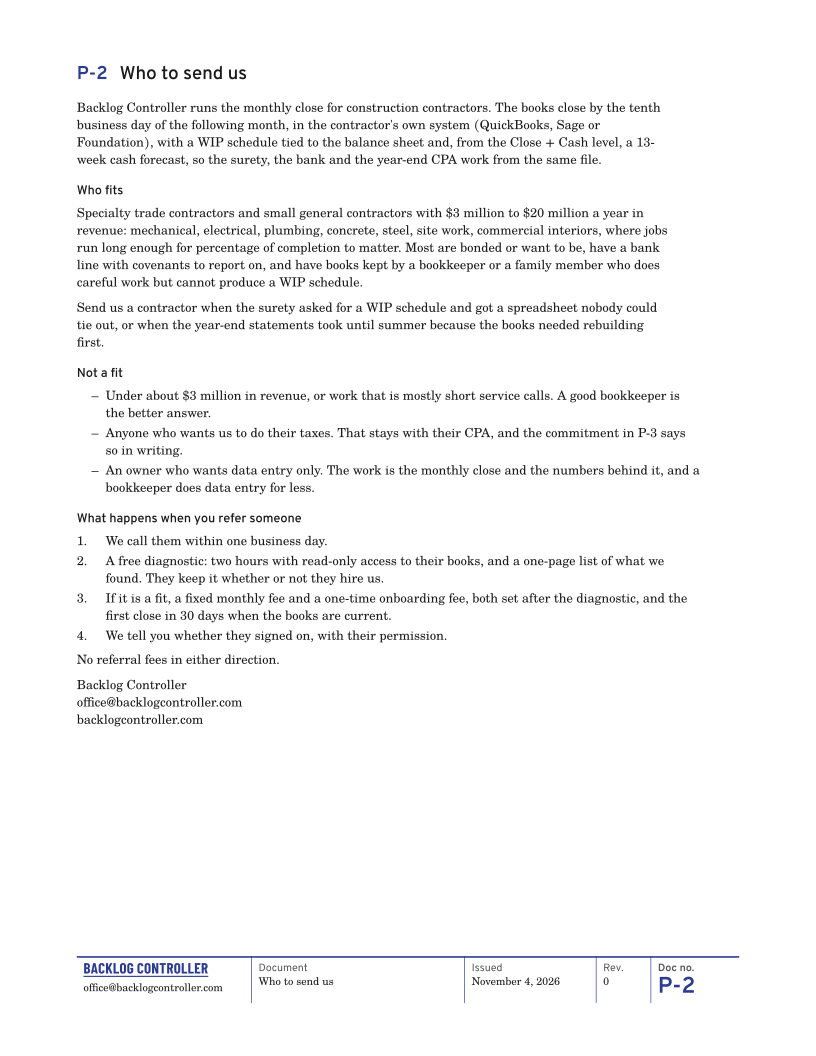
Who to send us is one page on which contractors fit.
Send us the contractor’s name and number, and tell them to expect our call. Or give them [email protected]. We call within one business day.
If the company fits, we spend two hours in their books on read-only access and send them a one-page list of what we found. It is theirs to keep. If they go ahead, a monthly fee and an onboarding fee are fixed in writing, and the first close follows in 30 days when the books are current.
Surety agents
Send us the contractor whose bond line was held flat or cut because of the books.
From the first close they have a WIP schedule that ties to the balance sheet within ten business days of every month end. Project managers update cost to complete each month, and completed jobs show gain or fade against the last estimate.
The package computes seven ratios and leaves receivables past 90 days and the related-party receivable out of working capital. The memo then tells the owner what to do about the ones outside target. This is what the sample package told its owner.
W-2Surety ratios
| Ratio | Value | Target |
|---|---|---|
| Current ratiooutside target | 1.37 | 1.50 or higher |
| Adjusted current ratiooutside target | 1.32 | 1.50 or higher |
| Adjusted working capital | 477,462 | |
| Debt to tangible net worth | 2.04 | |
| Underbillings to equityoutside target | 30.4% | 20.0% or less |
| Overbillings to cash | 0.51 | 1.00 or less |
| Line of credit utilization | 40.0% | 80.0% or less |
Adjusted figures leave out $48,560 of receivables more than 90 days past due, other than retainage, and the $25,000 related-party receivable. Tangible net worth is equity less intangible assets. Line of credit utilization is against the $750,000 limit.
Source: sheet F-2 and the receivable aging on sheet A-1. Targets are the levels sureties look for.
Decision 2 on the owner’s memo, sheet S-1
Ask the bank to term out about $260,000 of the line before the next statement date: the adjusted current ratio is 1.32 against the 1.50 sureties look for, a working-capital gap of $259,371 that collections alone will not close.
CPA firms
For a client you refer, the income tax work and the year-end statements stay with you, and the books reach you already tied.
The year-end file reaches you in the month after the fiscal year closes, and you start from books that need no rebuild. The contractor to send is one whose WIP schedule you rebuild every spring, or whose statements ran late because the books needed work first.
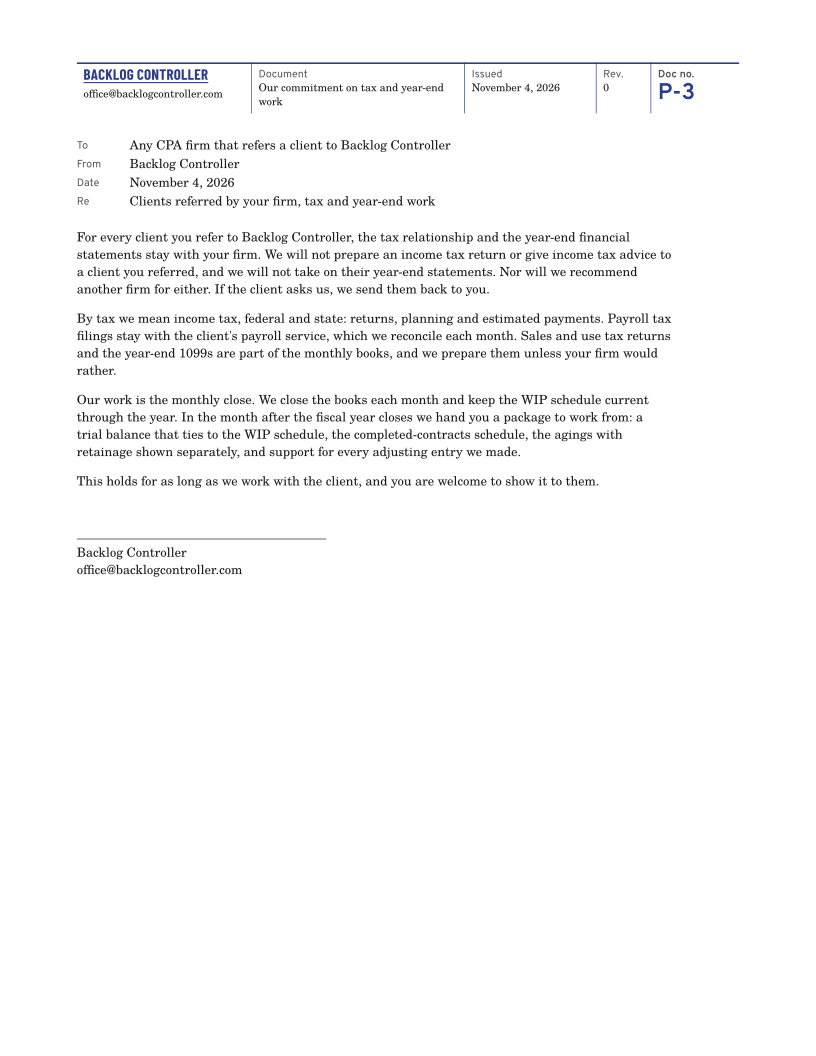
The commitment is in writing, in a letter from Backlog Controller you can show the client.
Bankers
A borrower who signs on has a balance sheet, profit and loss by job and cash flows by the tenth business day of every month.
Retainage, over and under billings and the current portion of long-term debt each sit on their own line, and receivables past 90 days are flagged. From the Close + Cash level up, the covenant calculation comes off the same closed books, and a borrowing base is part of the lender package on request. The owner signs borrowing-base and compliance certificates; we are listed as preparer.
One-page documents to hand over
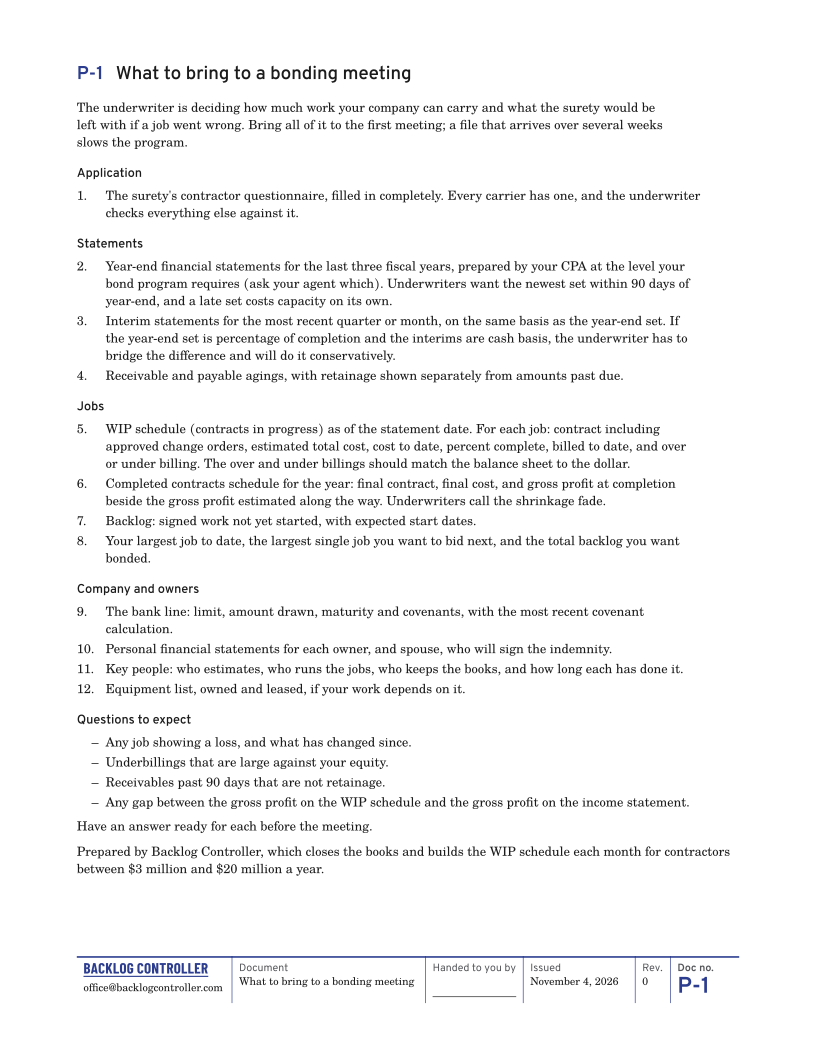
One to hand a contractor before a bonding meeting, one for your own file, and our commitment on income tax and year-end work in writing.